Humanoid Robot OEM vs ODM: From Requirements to Delivery
BXI Robotics provides OEM/ODM services from requirements analysis through whole-robot delivery, covering joint actuators, control modules, and system integration. Projects based on an existing platform may use 3–6 months as an early planning reference; actual schedules depend on customization, supply chain, testing, and certification requirements and are confirmed during project scoping.
What is the difference between robot OEM and ODM?
OEM typically focuses on manufacturing and integration to an agreed design; ODM also includes design and development. For humanoid robots, clarify who owns mechanical design, actuator selection, control software and testing before choosing an engagement label.
| Consideration | OEM engagement | ODM engagement |
|---|---|---|
| Project inputs | Existing design, drawings, BOM or production specifications | Application, performance targets and customization requirements |
| Main work | Procurement, manufacturing, assembly and testing to the agreed design | Design, component selection, prototype development and integration |
| Typical fit | An existing robot design needs manufacturing and integration support | A branded robot needs development on an existing platform |
| Agree in writing | Design changes, quality requirements, material substitutions and acceptance tests | Design responsibility, intellectual property, software deliverables and acceptance tests |
Both approaches require explicit responsibilities and deliverables. Start scoping with the Elf 3 humanoid platform and BXI robot OEM/ODM services.
What is needed for a custom humanoid robot quote?
Prepare the following inputs, marking unresolved items for assessment:
- Application and operating conditions: research, teleoperation or another intended use, environment, duty cycle and experiment requirements.
- Robot requirements: dimensions, weight, degrees of freedom, joint loads, motion range, runtime and power supply.
- Hardware and software interfaces: sensors, compute, ROS2 or other interfaces, simulation models and integration boundaries with existing software.
- Procurement plan: prototype quantity, expected production volume, budget, target date and delivery location.
- Validation and documentation: acceptance tests, certification needs, CAD, BOM, technical documentation and training scope.
Cost can include development, materials, machining and assembly, software integration and validation. A quote must correspond to a configuration and quantity. Confirm prototype pricing, production pricing and one-time development fees separately; minimum quantities are project-specific.
How should a robot OEM/ODM supplier be evaluated?
Review deliverable specifications, interface documentation, prototype tests and manufacturing responsibilities. Actuator selection should account for rated and peak torque, speed, weight and communication interfaces. Confirm what the SDK, simulation models and deployment support include. Compare quotes against the same configuration and acceptance criteria, including maintenance, spare parts and design-change procedures.
Engagement process
| Stage | Timeline | What happens |
|---|---|---|
| Intake & NDA | Scheduled with the project team | Collect requirements and sign an NDA if needed |
| Application scoping | Assessed after inputs are complete | Define specs, torque targets, and integration scope |
| Architecture and framework | Scheduled after scope review | Agree on architecture, milestones, and responsibilities |
| Development & delivery | Existing-platform projects may reference 3–6 months | Complete development, integration, and agreed validation |
Stage details
- Intake & NDA: collect application, budget, and delivery goals and sign an NDA if required.
- Application scoping: define specifications, torque targets, integration boundaries, and validation requirements.
- Architecture and framework: agree on the technical route, actuator and control selection, milestones, and responsibilities.
- Development & delivery: complete custom development, integration, and the agreed tests before delivery.
What can be customized
- Exterior: overall industrial design and brand visuals, for an identity distinct from the reference design.
- Structure: body structure and mechanical layout, with dimensions, joint arrangement, and load-bearing design tuned to the application.
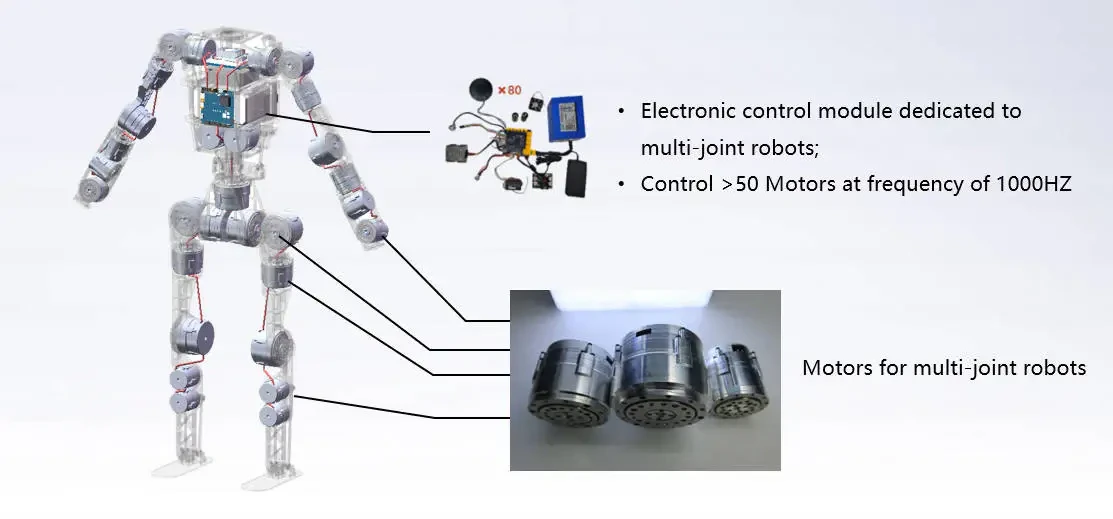
- Performance: performance parameters tuned on BXI joint motors, control modules, and whole-robot technology to match target torque, DOF, and control needs.
Why choose BXI for OEM/ODM?
- Full-stack in-house: joint motors (85/70/50 series, 25–150 N·m peak), PCIE-CANFD control modules (>1000 Hz), and whole-robot technology are all developed and controlled in-house, so customization depth is not limited by an external supply chain. See the joint motor selection guide.
- System-integration experience: the actuators have been integrated into multiple humanoid platforms, and the Elf 3 architecture can serve as a reference when scoping customization.
- Milestone management: scope reviews, design reviews, and validation gates make schedules measurable; the committed timeline is defined in the project plan.
R&D and manufacturing footprint
Custom projects are engineered by the Shanghai R&D team, with machining and assembly supported by the Shenzhen manufacturing team, connecting prototype development with batch delivery.
FAQ
What is the OEM/ODM lead time? Existing-platform projects with a defined scope may use 3–6 months as an early planning reference. New mechanisms, certification, or complex supply-chain requirements can extend the schedule.
What can be customized? Exterior, structure, and performance parameters, with branded integration built on BXI's joint motors, control modules, and whole-robot technology.
What does the process look like? Intake and NDA → scope confirmation → architecture and milestone review → development, integration, testing, and delivery.
What affects the lead time? Mechanical customization, software scope, sensor and compute options, supply chain, validation depth, and certification requirements all affect the schedule.
Is there a mature whole-robot baseline? Yes. Branded customization is built on the Elf 3 humanoid robot as a mature baseline — see the Elf 3 full specifications.
To start a custom project, contact us or see the OEM customization page.